Dalits hiding their castes, POKHARA, JUNE 22
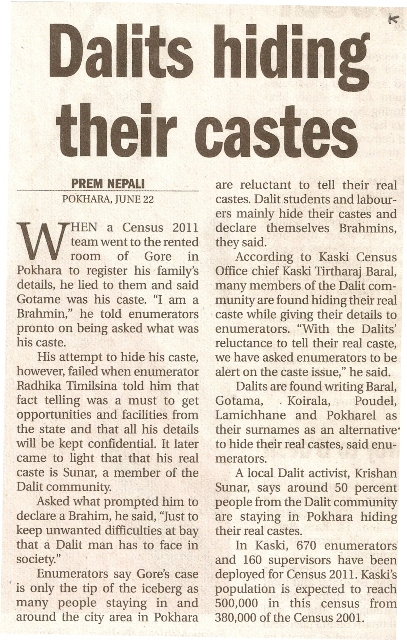
WHEN a Census 2011 team went to the rented room of Gore in Pokhara to register his family’s details, he lied to them and said Gotame was his caste. “I am a Brahmin,” he told enumerators pronto on being asked what was his caste. His attempt to hide his caste, however, failed when enumerator Radhika Timilsina told him that fact telling was a must to get opportunities and facilities from the state and that all his details will be kept confidential. It later came to light that that his real caste is Sunar, a member of the Dalit community. Asked what prompted him to declare a Brahim, he said, “Iust to keep unwanted difficulties at bay that a Dalit man has to face in society.” ‘Enumerators say Gore’s case is only the tip of the iceberg as many people staying in and around the city area in Pokhara are reluctant to tell their real castes. Dalit students and labourers mainly hide their castes and declare themselves Brahmins, they said. According to Kaski Census Office chief Kaski Tirtharaj Baral, many members of the Dalit community are found hiding their real caste while giving their details to enumerators. “With the Dalits’ reluctance to tell their real caste, we have asked enumerators to be alert on the caste issue,” he said. Dalits are found writing Baral, Gotama, . Koirala, Poudel, Lamichhane and Pokharel as their surnames as an alternative to hide their real castes, said enumerators. A local Dalit activist, Krishan Sunar, says around 50 percent people from the Dalit community are staying in Pokhara hiding their real castes. In Kaski, 670 enumerators and 160 supervisors have been deployed for Census 2011. Kaski’s population is expected to reach 500,000 in this census from 380,000 of the Census 2001.
Il concetto di casta da noi ha preso una piega particolare, va ad indicare soprattutto la classe politica.
La traduzione laica di un concetto religioso. Un concetto rivoltato come un calzino da Marx, da casta a classe, alla lotta di classe. Perché d’altronde, dove c’è una casta di privilegiati, di conseguenza c’è il suo complementare, la casta degli sfruttati. Il salto logico è immediato, naturale per molti, ma per altri è un’astrazione non completamente figurata nella sua pienezza. Ci sono persone più ricche, con più privilegi e poi il resto. Il resto, per alcuni, è la normalità accettabile.
Secondo un concetto basilare di uguaglianza, non dovrebbe andare esattamente così. Certo, c’è la moda della disparità in base a standard meritocratici, ma sappiamo bene che non si parla di questo, né in Nepal né in Italia.
In ogni caso nel continente indiano osserviamo come questa dialettica diventa esplicita, non solo la casta protetta, ma soprattutto la casta degli intoccabili. Immagino il povero dalit che prova a cambiare nome, per cancellare l’onta dell’appartenenza a un gruppo sociale condannato alla povertà e all’esclusione per motivi assolutamente estranei alla propria condotta. Un po’ come immaginarsi un “terrone siciliano” (termine odioso) costretto a trasferirsi a Milano per lavoro e che cerca di parlare lombardo per stare più simpatico agli indigeni. Sembra la tipica sceneggiatura di una commedia tragicomica di serie b, ma in fin dei conti è solo il continuo perpetuarsi dello sfruttamento dei più fragili e sfortunati.
